



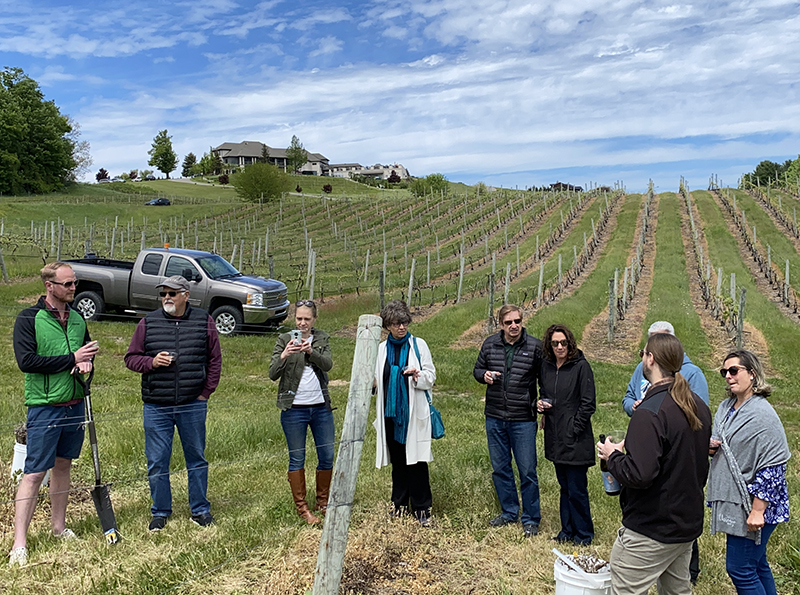
Innovative grape varieties called PIWIs being tested on a small scale in Michigan could have a big impact on sustainability and yield here.
Over two-thirds of Michigan wine grapes are currently Vitis vinifera European varieties suited to Michigan’s climate, such as Riesling, Pinot Noir, Chardonnay, Pinot Gris, and Cabernet Franc. Most, if not all, are susceptible to fungal diseases like powdery and downy mildew, both of which can hamper yield and fruit quality.
Short for the German pilzwiderstandsfähig, meaning “fungus resistant,” PIWIs are hybrids that have been developed in Germany and a few other European countries for decades and bred to be resistant to those fungal diseases. They require a fraction of the pesticides other varieties do, reducing costs and impact on the environment.
Chateau Chantal on the Old Mission Peninsula is among a few Michigan wineries testing out the newly imported PIWIs, with about a half-acre planted so far. Head Winemaker Brian Hosmer explains that his predecessor, the late Mark Johnson, originally obtained funding to spearhead research into cold-hardy and disease-resistant European grapes because he saw their potential for Michigan.
“We have been somewhat stagnant for hundreds of years in that the top five varieties haven’t changed that much,” Hosmer says. “Europe has gone on this track to try and develop disease-resistant varieties.”
Johnson worked with two local partners plus Amberg Grapevines in New York’s Finger Lakes region to introduce PIWI grape varieties from Europe to the U.S. He chose the first four types that were ultimately imported from Germany: whites Johanniter, Helios, and Muscaris, along with a red, Monarch.
The plants first had to be quarantined for a couple of years to ensure they were healthy before going into the ground at Chateau Chantal about six years ago, Hosmer says.
Andrew Backlin, president and sustainability chair at the Michigan Wine Collaborative and winemaker and proprietor at Modales Wines in Fennville, says Modales planted about 2 acres of Regent — another red PIWI variety — in 2019. “We’ve been very impressed with the results,” he says. “We’ve sprayed about half as much as with Vitis vinifera.”
Derrick Vogel and Izabela Babinska, husband-and-wife owners of Folklor Wine & Cider south of Charlevoix, have planted about 800 Muscaris vines. They did a light harvest in 2025 and are using the grapes in an estate blend. In 2026, they’re planning to make a stand-alone batch to “really see what it can do,” Vogel says.
“We’ve done a really small batch two years ago,” he says. “I loved it. It has pretty unique aromatic profiles.”
Small batches made from the Old Mission-grown PIWIs were offered for tastings at the 2026 Northwest Michigan Orchard and Vineyard Show.
“They tasted pretty good,” Hosmer notes. “They’re very different varieties. Flavor-wise, they’re all pretty interesting.”
Backlin says Modales began making wines with Regent grapes in 2022, using them for its annual Nouveau last year and blending them into rosé. “We’ve played around with it,” he says. “It’s been very versatile. It’s just getting to know a new grape.”
Backlin says Michigan State University has been a collaborator on “newer generations” of PIWIs. “There are many new hybrids that are much better than Regent,” he says. “It’s just what nurseries had when we planted it.”
Even as PIWIs spread on a wider scale, Hosmer notes that the public will need to be educated about them. “People aren’t familiar with the varieties and the names,” he says. “You might suggest they try this Muscaris and they [say], ‘What’s that?’”
But Backlin says consumers will want to get to know them.
“PIWIs bridge the gap” between French-American hybrids and vinifera, he says. “They make great wines and are better for the environment.”
Advanced sommelier Amanda Danielson, who owns Trattoria Stella in Traverse City, has been working with MSU viticulture professor Paolo Sabbatini to seek grants that could advance PIWI grape growing in Michigan.
“I don’t think PIWIs are going to replace vinifera — nor should they — but what they can do is offer an alternative to grape varieties that have historically been difficult to grow or cause crop loss,” she says, adding, “We’re talking about farming PIWIs with the intention of making wines that are world class.”






Facebook Comments